Dial G for Robinson 7: Little Caesar

Welcome back to our monthlong journey into the legendary 28 “perfect” movies of Edward G. Robinson. This is the big one. This is Little Caesar.
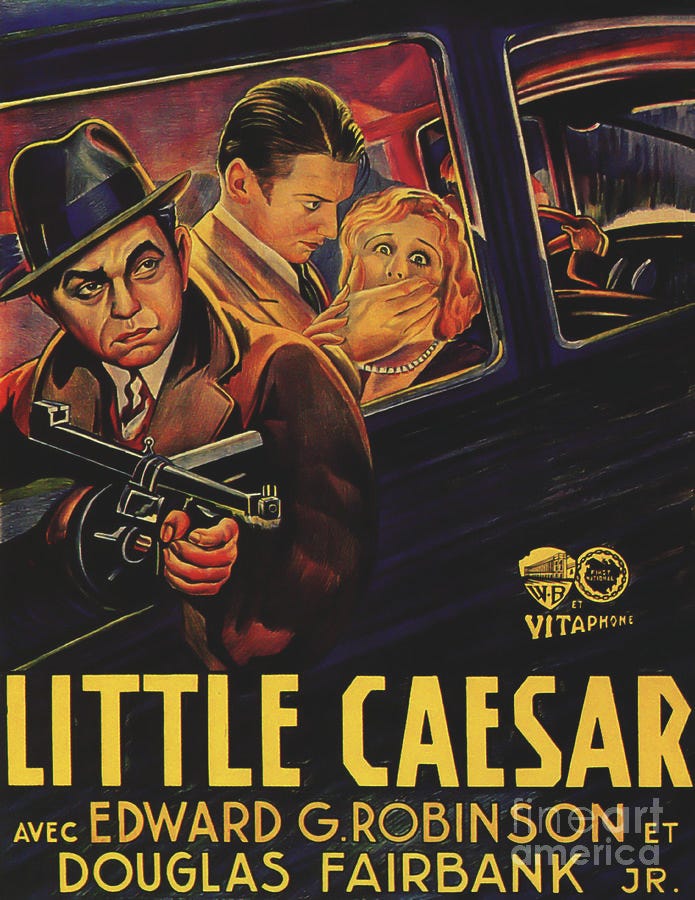
Louisa May Alcott’s Little Caesar. The story of a man who turned his back on a life crime to invent the pizza pie.
Seeing this after a lifetime of watching gangster flicks is like hearing the Stooges for the first time. I was giddy and grinning before the sneering raw power of a genre being born.
We meet EGR as Rico and Douglas Fairbanks, Jr. as Massara, two small time hoods, eating spaghetti and coffee in a roadside diner, dreaming of the big city. Rico decides to make his move, while Massara, no Lady Macbeth, gives it all up for his fallback career as a nightclub dancer. It was the Depression!
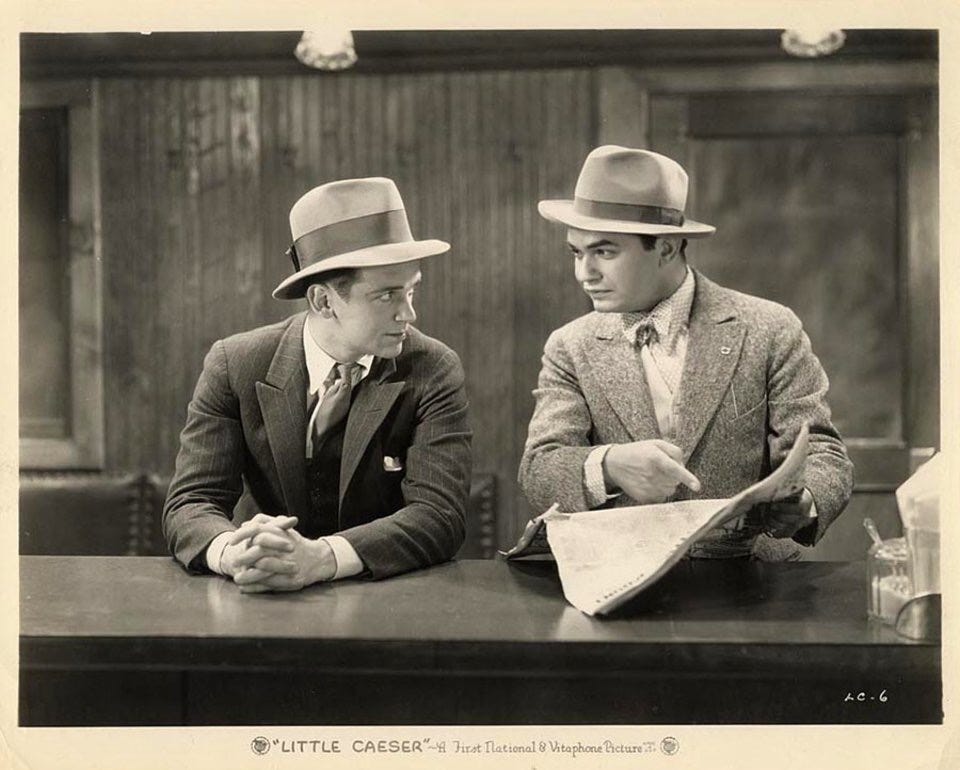
Rico begins a ruthless rise to the top of the Big City syndicate, making enemies along the way with his hubris and itchy trigger finger. Massara, meanwhile, is hoofing at connected nightclub. There’s a brief dance scene. It’s not great, but it sets a precedent for musical numbers in crime flicks, a sadly lost tradition. Melville got it. One of my faves is the opening sequence of 1970’s Le Voyou.
Massara’s girl, Olga, finds a gun in his tux, and he laments the gangster life that he’ll never be free of.
Rico is christened Little Caesar by Sam Vettori—played by Stanley Fields, a great face in a movie full of great faces—the midlevel boss Rico quickly usurps. In the course of one stick up, Rico both turns the screws on his old pal Massara and rubs out the Crime Commissioner. Things escalate.
The plot is basic, the characterizations are thin. The movie mostly succeeds on EGR’s gloriously unhinged performance. He makes a meal of every line. He singlehandedly justifies the recent adding of sound to motion pictures. Though he probably would have made it as a silent film star. We would have missed out, though, on the single best closing line in cinematic history (sorry, Some Like It Hot).