Dial G for Robinson 9: The Stranger

We are well past the halfway mark of this diminutive month and only at number on on our goal of watching all 28 of the supposed Perfect Movies of Edward G. Robinson. Well, we’ll always have The Stranger.
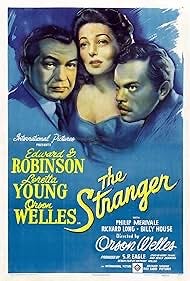
Who is the stranger of The Stranger? There are three candidates in this 1946 picture that’s described as Orson Welles’s first noir. The first is Konrad Meinike (Konstantin Shayne), a German war criminal mysteriously released from prison in the ominous opening scene. The second is Wilson, played by our man, the one who let Meinike go, and then followed him to the idyllic Connecticut town of Harper. The third is high school teacher and clock maniac, Charles Rankin (bug-eyed Welles himself), who we learn rather quickly is actually the brains behind Hitler’s concentration camps, Franz Kindler.
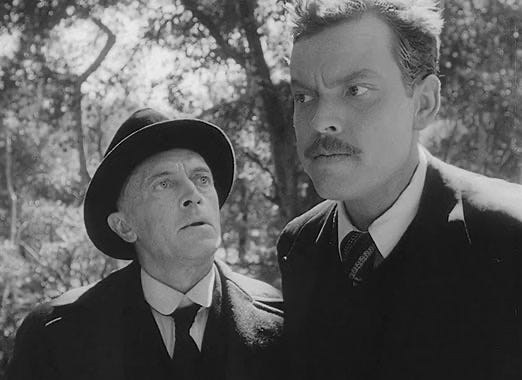
Unlike most of the other entries on our G-Man marathon, this isn’t a flawed but enjoyable movie with flashes of the sublime. The Stranger is a really good movie that if recommend to Robinson freaks and non-freaks alike.
Robinson’s Wilson is a procedural sleuth, a departure from the pathetic antiheroes of his noirs with Fritz Lang. I made a Maigret comparison in my review of A Bullet For Joey, and it’s even more apt here. Wilson is a much more complex character and a bit more zesty than Bullet’s generic Inspector. He’s almost a proto-Columbo. He tells people he’s an antiques dealer but he doesn’t tell them the antiques he deals in are war criminals!
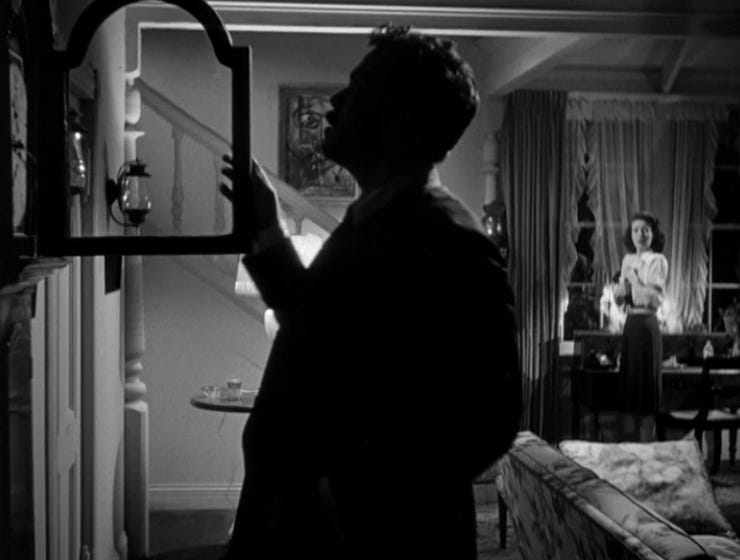
The Stranger came out in 1946, months really since the war had ended and the world learned of the horrors of the Holocaust. There’s a scene where Wilson shows Rankin’s wife and father-in-law documentary footage of death camps shot by Allies during the liberation. Welles had agreed to give the studio control over how the film was edited and it’s clear there was a more political movie in there. Traces of it show through, such as the way Wilson confirms Rankin really is a Nazi. Welles editor-proofed much of the film with long, elegant takes.
The lighting is fantastic, especially in some of these longer takes where actors move in and out of shadows.
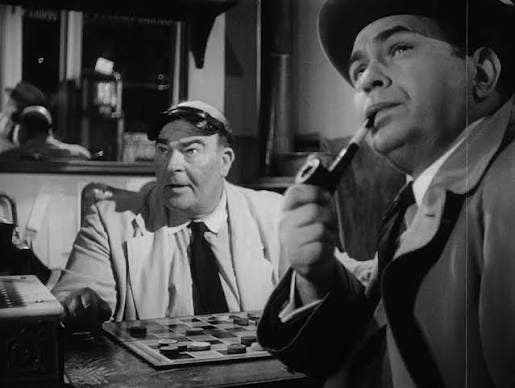
Billy House steals every scene he’s in as Potter, who runs the general store, and indeed much of the town from behind his counter, where he likes to play checkers for 25 cents a game. These checkers matches are some of the most vibrant scenes in the film, especially one shot over Robinson’s shoulder that has him turning to look out the window frequently. It’s like nothing you’ve ever seen!
I’ve enjoyed all of the films so far, but this is one I bet I’ll watch again. I still have Key Largo and Double Indemnity to look forward to. What are some other Edward G. Robinson flicks I shouldn’t skip as I flail through his catalogue? Let me know in the comments!
John Ford's The Whole Town's Talking has a great EGR performance. Two actually!